
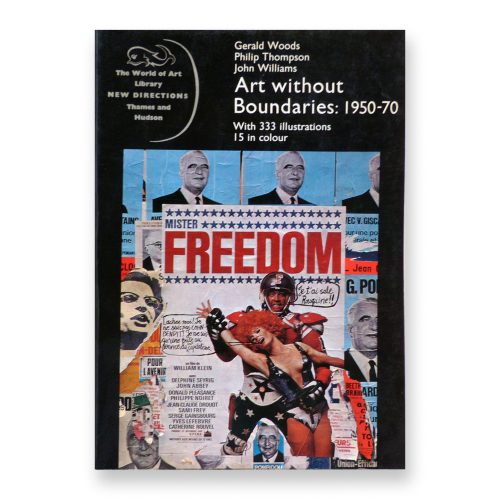
Watching a recent video from Unit Editions, I came across Adrian Shaughnessy discussing some of his most treasured design books. One title he mentioned was Art without Boundaries: 1950–70, a book he returns to time and again for its early exploration of the relationship between graphic design and art. That was enough to send me searching for a second-hand copy.
Diving into the book, it’s immediately apparent that it was written in the late 1960s and published in 1971. The writing is quite academic, occasionally adopting a rather refined and elitist tone. It’s very much a product of its time and probably best approached with that in mind.
Despite this, I found it an interesting read. It provided some valuable background on designers and artists whose work I was familiar with, but whose stories I knew less about. There’s something enjoyable about discovering the thinking and influences behind work you’ve admired for years.
Does it still have value for today’s designers? I think so. Beyond the historical perspective, it contains some lovely examples of work from the period and captures a time when the boundaries between art and graphic design were being questioned.
It’s earned its space on my bookshelf. Not because I agreed with everything it had to say, but because it’s interesting to see how designers thought about their work more than 50 years ago.